Interview was previously published in 2014 during the US release of Pride
Dominic West is best known for some intense dramatic roles such as Jimmy McNulty on The Wire and his award winning performances in Appropriate Adult or The Hour. But the charming and gregarious veteran actor is also skilled in comedy, as he shows in the new feel-good dramedy Pride. Playing real-life actor turned activist for LGBT and AIDS issues Jonathan Blake, West is a standout in an ensemble cast which includes veterans such as Imelda Staunton, Bill Nighy, Paddy Considine, and Andrew Scott. West shows his comedic side in Pride, but is back to high drama when he returns to series television in the sexy thriller The Affair (opposite Ruth Wilson, Maura Tierney, and Joshua Jackson), which includes enthralling he said, she said approach to the narrative. West sat down to discuss his role and the film Pride in New York City, where I had to break the news to him that the film had lost the Toronto Audience Award to another UK production, The Imitation Game. He seemed genuinely disappointed to learn the news about the loss…
West: The AUDIENCE award? Were they standing and cheering for that film? They were standing and cheering for 10 minutes at ours.
I heard, congratulations
Thank you…But we didn’t get a prize
But who cares?
I care deeply (laughs). But go on.
Well, let’s talk about the two films then. The Imitation Game and Pride are coming out around the same time and they both deal with significant moments in history and both have homosexual characters in leading roles who made a huge impact. The Imitation Game is a far more serious and darker film, while Pride is funny and rather hopeful. Was that part of the appeal for you to do this film?
Well, it is a bit more user friendly. The film could have failed on so many different levels, it could have been offensive, but so is the strength of the writing that it didn’t. It manages to be generous about everyone, except Mrs. Thatcher, she doesn’t come through with flying colors. But it has what great writing has which is, you see where everyone is coming from and why they’re doing what they’re doing. Even the evil ones.
I was talking with Andrew and he mentioned that in other movies, you would have switched roles, because he’s been playing more flamboyant characters recently and you’ve played a lot of intense characters.
Me (laughs), oh I prefer playing the loud flamboyant characters. This is the real me; the mullet, the flair.
Was there anything about this character that was like you in the 80s?
Well, I was of course far too young, but the 80s were an unspeakable misery for me. The miners’ strike coincided exactly with my adolescence.
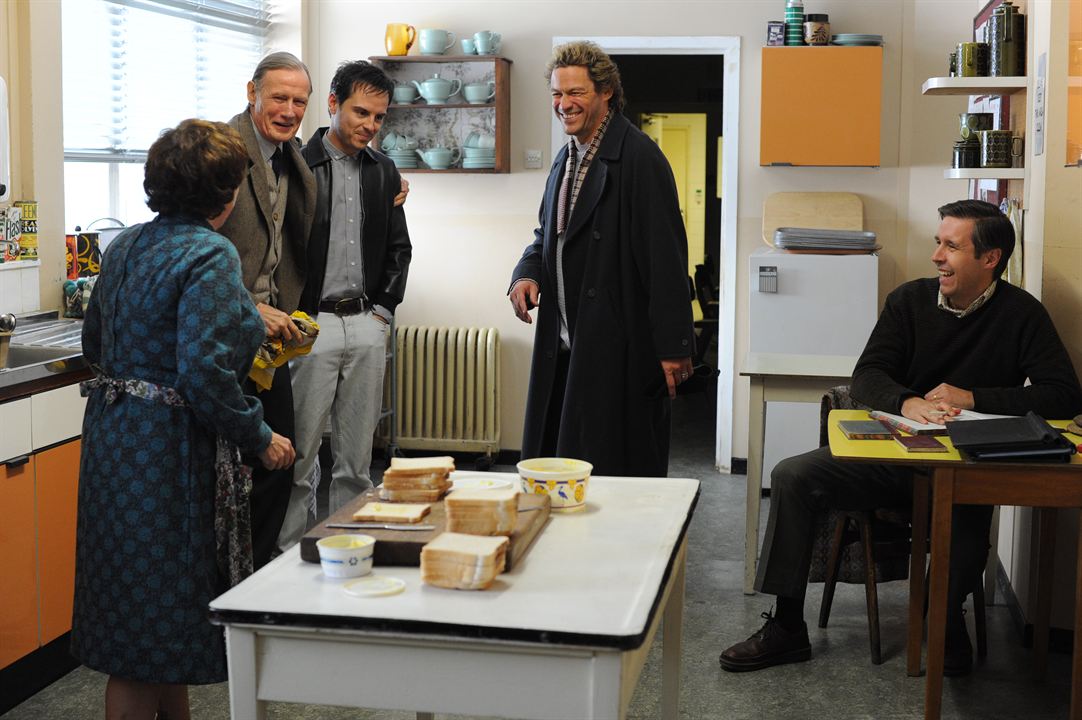 Were you familiar with the story of the miners?
I wasn’t familiar with this specific story of how the gay and lesbian group helped the Welch miners. But I was 13 when it happened so I remembered it of course. It was all around, because I grew up in Sheffield, which is the headquarters of the miners’ union. I was conscious of it, but it hasn’t really been talked about since, which is why I’m glad it’s being talked about now. And it’s so good to be discussing it from an optimistic approach.
Apparently the story was barely covered in newspapers at the time. Why do you think the story wasn’t reported on at the time?
Part of what bound these two groups together was the fact that they were being vilified by the press. The press in the UK was largely right-winged and pro-Thatcher, and there was horrible stuff about the miners and the gay community being written. So they were really being, not just underrepresent, but attacked in the media. The newspaper article we read in the film is a real newspaper article, and then you think…that wasn’t that long ago. But it would be illegal to write that now, I would think.
Is the UK press still more conservative?
It’s difficult comparing, because I always think America is more conservative in general than England, so what we would consider moderate, Americans might think is socialist. So Americans might think this film is incredibly left wing. Or, does it perhaps override all that.
I don’t know, but I think there will be a lot of audiences who will go to this movie, who otherwise wouldn’t have because it is being promoted something of a feel good movie. I guess it is liberal movie, but it certainly could find a broad audience.
Absolutely, and this movie would be a hard sell if it were a more serious take on the same story.
How did they come to you with the role?
I don’t know why they came to me, but I’m glad they did. I’d auditioned for Matthew a couple of time for theater. He’s a wonderful theater director who I always wanted to work with, but he didn’t want to work with me (laughs). But I must have done something right, because he called me up and said have a look at this script. And I loved it immediately. But I don’t know why he choose me, I’m just so glad he did. And it was perhaps a bit of a risk, so perhaps either other people said no first or they weren’t prepared for it to be as much of an ensemble piece.
What is risky about the role?
That I would go over the top and be giving the straight man’s view of what is gay. And just fake in some way. I mean, I couldn’t really be too flamboyant but you can get it wrong. It took some consideration of how to get into the mind of this gay man, but it’s the same consideration you have getting into the mind of any character.
Playing a real person who was available during the production, was there anything he told you that helped you stay centered or connect?
He talked a lot about when he discovered he was HIV+ and all his friends were dying and how terrifying that was. And he said that a lot of his friends were dying because of the drugs they were being given and told me, ‘the only reason I’m still alive is because I refused to take those early treatments.’ He was living day to day, but pretty much in despair, until this subject came up and he realized he could help other people and his life had a purpose that wasn’t just about himself, or even just about his people. I think he got great strength and motivation to keep living. And once you hear that, you think “I have to not fuck this up, and what an incredible arc for a character to have.” To be in the pit of despair and find a sense of purpose in helping other people.
That really is one of the great strengths of the film, because while it is important to advocate for yourself and your community, there also power in helping others, as the LGBT group did for the miners and the miners did for them. What do you think the film is saying about activism?
I think it is a crucial realization that everyone’s battles really are the same, no matter how differently they appear to be. They are very often fighting the same thing, which is usually prejudice, and fear of the unknown. So the great tagline for this film was “prejudice cannot survive proximity.” And the two things this story teaches is to find the common humanity above your particular cause and being out and proud, without being confrontational, can overcome prejudice.
When you work on a film that is such a large ensemble, with so many accomplished actors, is it intimidating to know you only have a couple scenes that highlight your character?
It was really fun being around that many people, but it certainly is the case, especially being around people like Imelda and Bill. When it is your turn and you might only have three good lines…you’d better deliver. And I feel I went a little flat a couple of times. But the ensemble can lull you into a false sense of security because you start thinking, we’re all having some fun and then suddenly, the spotlight is on you and you’d better be ready. And I’m not sure I always was.
When you work with actors who are younger, up and coming actors and legends like Imelda and Bill, what does that do to the atmosphere on set?
It is great. The more professional people are and better they are at acting, they tend to piss around more because they can. Within professional limits of course, but they tend to have more fun because they are so damn good at it. And that’s how Bill and Imelda are.
How long did it take to get your dance routine down for this movie?
I keep saying 4 months, but that isn’t really true. But it felt like it. And I was working pretty hard, because I was shooting a pilot here in New York, so I had a choreographer and went to dance studio on Broadway, and I couldn’t believe it. It felt like I was in a chorus line or something, it was a dream come true…I felt like Leroy in Fame. And I was terrified when I did it. And then two days later, I left to take this walk with wounded soldiers in the North Pole, so I was quite worried about that. And when we were walking, I was asked “what training have you done for this?” and I said “a bit of yoga, and a lot of disco.” And he looked at me like “I’m going to pick this guy up.” But it’s actually quite tough stuff disco and it gets you fit.
 You’re going back to TV with The Affair next month, do you find you have to change the way you actor or play a character in TV compared to in film?
I suppose you do. It is all the same stuff, but what is so great in film is there is a finite amount of time that you can concentrate on. And what is so difficult about television is that it just keeps going on. And there is also the fact that, if you have a big part on a television show, there is less of the sense of having the spotlight on you for a moment, so you better let the character shine when you can. But with The Affair, we have 10 hours, so I can reign it in a bit.
 Favorite Performances